Activities
[Interview] Interview with DEZINE Magazine
2011
DEZINE Magazine
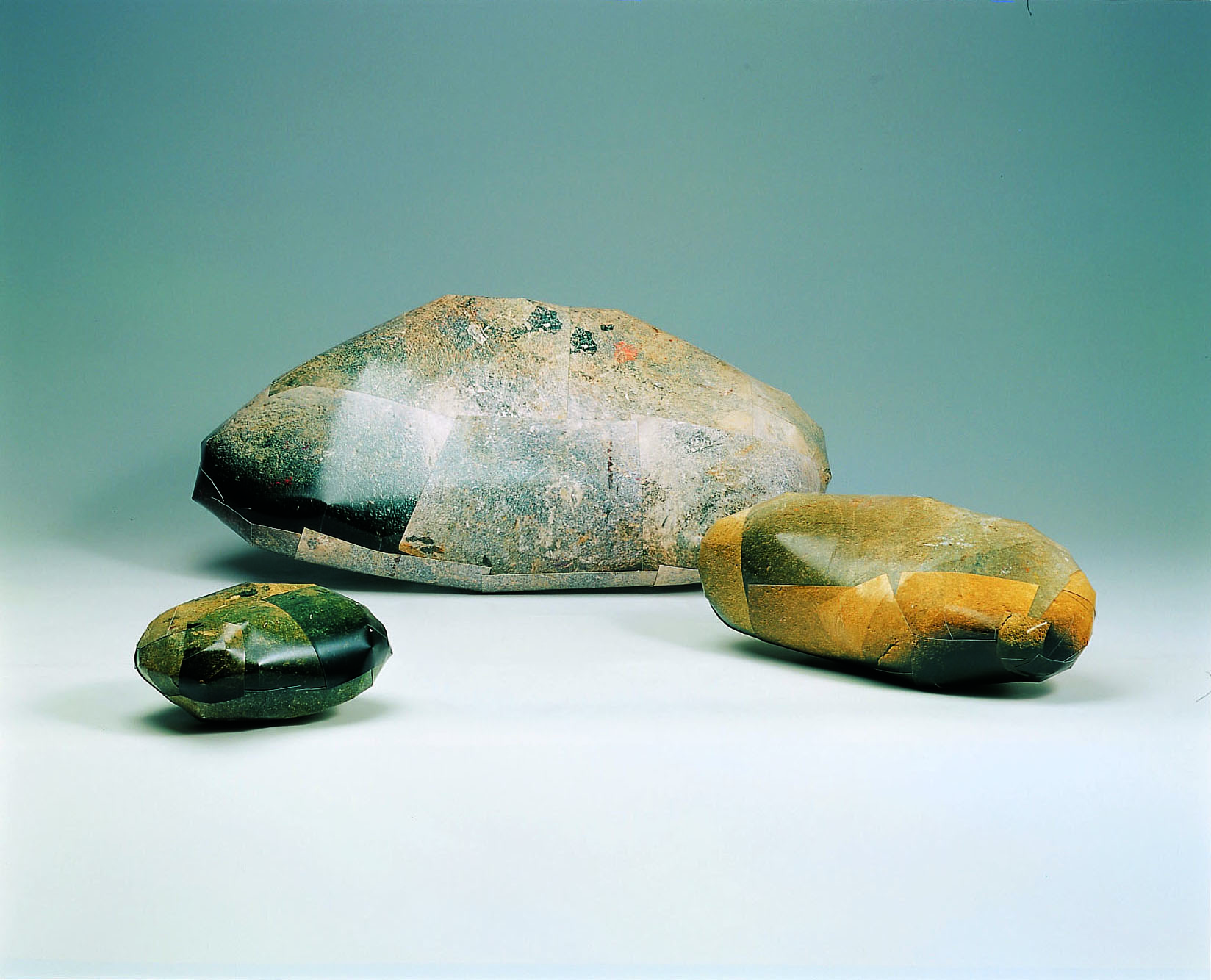
Under able Heaviness, 1999, C-print, Mixed media, 120 x 100 x 40 cm ©Artist
What was your departure point for creating this new so called “photo-sculpture” or “hybrid sculpture”? Did you set your mind on discovering a new genre of sculpture from the beginning, did you wish to challenge traditional norms of sculpture by means of deconstruction or was it just an experimentation that came out right?
I had started the work since 1998 when I was a university student, and made a debut in Seoul, 1999. Traditional sculptures such as trees or rocks are too heavy to be handled on me. That is why I tried to make lighter sculptures.
How do you choose your subject matter each time you set up a new project?
Things that could be found in everyday life are usually included in many cases. I always try to find out and make my own way more economically and effectively while I am doing work as an artist.
Can you describe the development process of your works, in terms of the different stages involved in it, time for completion of each work, use of materials e.t.c. ? Which is the most important or difficult part of this process?
When Deodorant type came out first, inside the photo was empty. As the piece got bigger, light material such as aluminum stick or polyethylene holds the inner frame. At first, photographic paper itself hold the frame, and it leads to distortion of the frame. Recent works have more normal forms. What’s more, whereas the former doesn’t have coated plastic, the latter have one so that it strengthens durability.
One work takes normally two month or more. Recent work such as
Much of your work is linked to advertising and today’s consumer oriented culture. What is it that fascinates you about it?
People in contemporary metropolis are exposed to consumption culture like advertising directly or indirectly. I don’t think I am fascinated by it, rather I show the world we are living in together.
How do you decide on pose and scale of your models?
There are cases that some of images in my mind are corresponded to the poses of commercials and art historical sculptures and paintings. Sometimes I’ve matching up the pose in my mind with the traditional and classical reference.
What is the hidden thread of your series of work? Is there a social, political, psychological, philosophical or other narrative you want to develop?
I have interested in showing the generation that I live in now. There is nothing to be left yet as well as they have everything inside.
Going through the titles given to your sculptures one could find them rather intriguing. How do you decide upon them? Foe example, your famous “Deodorant Type” carries in its title a certain feeling of irony and sarcasm about the superficiality of the modern world.
Some work of arts was titled very long and plausible from 1998 to 2001. Nevertheless they mean “untitled” to me. I was trying to name ‘untitled’ on the works. As the number of art work increased, it is hard for me to memorize one by one. Simple and short title is more convenient to be remembered. Isn’t it lack of sincerity named as ‘untitled’ for ‘untitled’?
What do you consider as the biggest misconception surrounding your artwork?
It is the biggest misunderstanding that my work including all series of deodorant type, the flat and the sculpture is focused on the combination of photos with sculptures.
How would you describe the art of Osang Gwon if you were given only 5 words?
Sculpture, contemporaneity, wackiness or inconsequence, misunderstanding and error.
Could you name your biggest artistic influences or inspirations in terms of artists, ideas or artistic movements?
I was born in the third-world country’s big city as a member of a middle-class family and brought up with seeing all the generations of arts through the magazines. Other things are The ‘Seven Wonders of the World’ when I saw in 80s on the magazine, U.F.O and Novels by Murakami Haruki.
Which of your projects has given you more satisfaction so far and why?
Solo exhibition at Manchester Art Gallery made me very satisfied with all the process from exhibition preparing to publishing catalog. In addition, solo show at “museum” will have higher probability that is remained in art history.
Your line of work includes collaborations with the music band KEANE as well as big corporate brands such as FENDI and NIKE. Since it’s rather common these days for artists to engage themselves in the world of pop culture and mass media communication of brand products, how do you reflect upon this kind of dialogue?
I’ve working positive in that more people could have encountered my work of art than other common exhibitions.
Nowadays sculpture seems to take a greater space in the public space, artists are commissioned more and more by institutions to produce works of art that can be staged outdoors to deliver a message or celebrate a particular idea. Do you see it as the return of sculpture as a more dominant art of form in the modern world?
I think there are lots of ranges in the category “sculpture” propaganda is just only propaganda. It had nothing to do with contribute to studies like arts of mankind.
What is the most unforgettable piece of art you have seen in your life, one that stands the test of time and originality?
Motorcycles by DUCATI
What is you next artistic project?
My work is included in 'the flat' and 'The sculpture' series with 'Deodorant type' series introduced in overseas. The sculpture was shown in the recent solo exhibition《Bike Torso》that I was preparing for 4 years. The other 'The Flat' will be soon came out. I preparing solo exhibition at Seoul and Berlin this year.
Do you have a motto that conveys the essence of your work or your existence as an artist?
Thin, long and harsh
Activities