Interview
2006 Gwon Osang's Interview for Solo Show at Arario Gallery
2006
Sculptor Gwon Osang & Curator Juhl J. Lee.
This is a compilation of interviews of sculptor Gwon Osang conducted by curator Juhl J. Lee.
I. Gwon Osang, The Sculptor
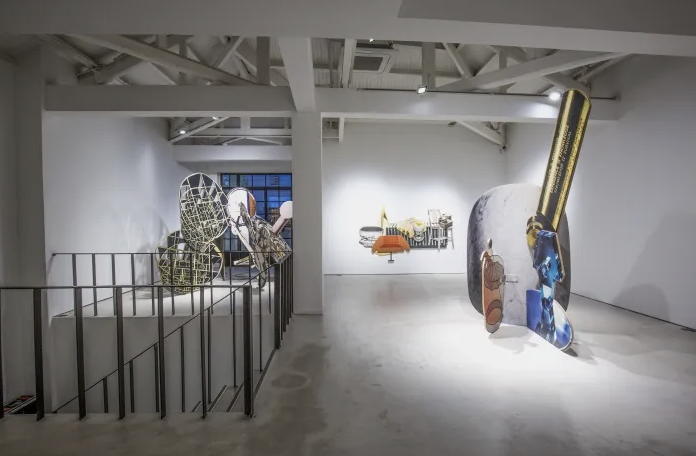
Juhl: When we think of the artist Gwon Osang we think of sculpture that is closely related to photography. In your work ‘Deodorant Type’, you used photographs to create sculptures, and in ‘The Flat’ you cut out pictures from magazines to make sculptures and captured them by camera. But this time you sculpted a car using a conventional material, namely bronze, and titled it ‘The Sculpture’. I'm curious why you chose a super car as your object?
Osang: For quite some time now I've wanted to create something that anybody could see and recognize as a sculpture. And I was very interested in doing something still-life. Of course the object could be anything, cosmetics, watches, jewelry... But I've already dealt with them in ‘The Flat’ series. The basic idea of ‘The Flat’ was to make a two-dimensional display of sculptural installation. No matter how strongly I argued that The Flat series are sculptures, the audience would not perceive them as such. So I decided to make the 'traditional' sculpture, a still-life sculpture of any object.
I wasn't thinking of making a car initially. In the beginning I played around with cosmetics, a Parka ink pot, a Mont Blanc fountain pen and a Motorola cell phone and cast them in bronze. They were little more than replications of the actual objects in bronze, but this kind of experimentation led me to think that I could just about make anything: a refrigerator, an air conditioner... until I thought of making a car. A car is one of the most modern objects and I wanted some connection with other objects I'd dealt with in ‘The Flat’. And I didn't want to make a car that was too common, like a Hyundai or a Citroen, for example. I wanted something out of the ordinary, like a Lamborghini Murcielago or Enzo Ferrari. I did a lot of research on cars and I found that 'super cars' are perfect as objects of an academically rendered modern sculpture.
'Super car' makers to me are creators of modern art. They spend lots of money making cars that are useless. Take Bugatti Beyron for example. It takes years of R&D to make one model, and it boasts engine power of 1,000ps. You can never fully exploit that kind of horsepower on the public road. And the car is so small you can barely fit two people in it. If you look inside there is little that adds to the passenger's comfort. Yet people go crazy over this car. I tried to come up with an explanation and suddenly it hit me that it was like contemporary art. Another thing that makes cars and bikes great objects for artistic creation is that they are often designed with the human body in mind.
Murcielago, Enzo and Beyron in my studio looked to me like works of Aristide Maillol. When you learn to sculpt, you are often exposed to the works of Auguste Rodin, Aristide Maillol, or Bourdelle. And I think my choice of cars was in a sense in tune with the way old master's chose their object. Before starting a piece, I would ask myself what Rodin would have sculpted had he lived in this age. I'm not Rodin and I have no detailed knowledge about his life, but I thought that had Rodin or Michaelangelo lived in this day he would definitely have sculpted a car.
Juhl: Which aspect of sculpture did you focus on in ‘The Sculpture’?
Osang: At first, the material. This piece can be summarized as: "A super car made of bronze". Bronze is not so heavy when you make it thin. In fact, paper mache made thick can be quite heavy. Sculpture contains conceptual discussions that are mental. And I pondered deeply about the words and concepts related to such materials.
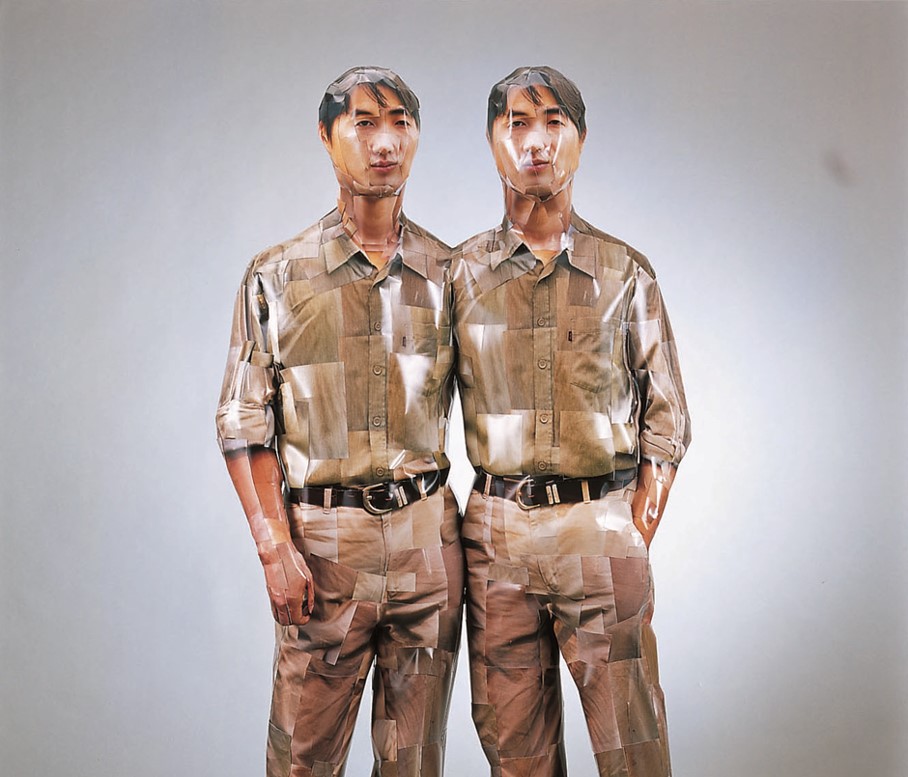
Juhl: You are known as the pioneer of photographic sculpture with your innovative works like ‘Deodorant Type’ and ‘The Flat’. And you've now made a U-turn to conventional sculpture. Can you briefly tell me how you conceived such novel ideas about sculpting? I have heard that you began ‘Deodorant Type ‘with the intention of creating light sculpture.
Osang: More recently people came to know that my aim in the ‘Deodorant Type’ project was to make light sculpture in the beginning. If you're majoring in Sculpture in the university, you often work with materials that are heavy. And here people learn to believe that one must use conventional material and do welding and stonework to create large pieces of artwork. When I'm working I often have to move my piece, but it would often be too heavy, and I decided to make something light. As a student I had a motto: never make anything that a friend and I can't easily move. But even when the piece is actually light there can be other difficulties. I made a small van once, and fortunately it was light enough for two people to easily carry. But it was big and so it was hard to find a place to store.
Juhl: You broke away from the conventional heavy sculpting and introduced two-dimensional sculptures with ‘The Flat’. Yet you maintained that you are sculpting. As you attempted such cross-overs of genres did you consider deconstruction of sculpture or transition to another genre?
Osang: When I was working on the ‘Deodorant Type’ there were invitations from photographers to do some joint work. There was, for example, a proposal to do a duo exhibition with a well-known photographer in Amsterdam. And around the time I held my 2001 exhibition, I submitted my works to a photography competition and made my debut as a professional photographer. But for me photography was not very interesting. Not to say that photography as a genre wasn't interesting, but the people in that field, the photographers were not interesting.
This is my personal opinion but I think they are different from sculptors. I think it was after I came to this conclusion that I started calling myself a sculptor in my third year in the university. I made my first set of namecards, I chose a very traditional font to make them look like a card of a stone craftsman, that read "Gwon Osang, Sculptor" pressed and printed. That was the time I was doing my ‘Deodorant Type’ series. I think I wanted to emphasize my identity as a sculptor by choosing an old-fashioned namecard even though my work itself was very modern. Frankly, I don't really look like the typical sculptor, but I wanted to project myself as a sculptor.
Juhl: People who are unfamiliar with you may have taken you as a photographer more than a sculptor, but you have continued to sculpt, and with ‘The Sculpture’ you are finally showing more of the sculptor side of you. And your bronze works of 'super cars' are very timely, so to speak. Paintings have begun to recapture the fancy of art lovers since a few years ago, and there was quite a response to the recent "The Triumph of Painting" exhibition at Saatchi Gallery. I thought perhaps you'll be able to provide the starting point for "The Triumph of Sculpture" with ‘The Sculpture’. Have you thought about such possibilities as you worked on ‘The Sculpture’?
Osang: Yes, I have. A couple of years ago when I worked in the Seogyo-dong studio I would say to my sculptor friends "There will come a time when sculpture becomes a more dominant form of art." And those friends were working more with traditional form of sculpture. I wasn't saying it just to cheer them up but because I really believed it myself. And I have told many people that I would do traditional sculpting in the future. But when I talked about my automobile project people seemed worried about my choice of object. They were worried because many other artists have created sculptures of cars. So before I started ‘The Sculpture’ I did research on the artists who have made sculptures of cars and looked at their works.
The sheer number was overwhelming, and it was exactly as people had warned. But I thought it was actually a good thing. The number of so many works done on cars means that it is a very contemporary object. And while it's true that many have worked on the car motif, no one actually made a car. There were sculptors who took real cars and turned them into installations, but no one actually made a car with their own hands from scratch. It is also important to note that I have never seen a super car. To make a model for my car, I looked at magazines and researched through the internet to gather measurements and details. It is funny though, I actually had a chance to see a real Lamborghini but at the last minute, I chose not to go see it.
Juhl: ‘The Sculpture’ is not a photographic sculpture like ‘Deodorant Type’. It is made of bronze and is exactly what anyone would expect of a sculpture. Looking at the entire spectrum of your work it looks as if you are headed in a certain direction about the concept of sculpture. In ‘The Sculpture’, were you trying to return to the basics so to speak?
Osang: I can't say I didn't. I thought that with ‘The Sculpture’ I would be able to show what sculpture essentially was. But as I worked on it I realized that this form of art has lasted several millennia for a reason. It embodies something that cannot be expressed in words. I was physically tasked as well as mentally. Because I'm known for combining photography with sculpture people are not aware or don't like to admit that I am very good at modeling. An old friend of mine saw ‘The Sculpture’ and said: "You have sculpted but like your other works it looks so two-dimensional."
Another sculptor friend who was standing next to him added that his own works are very three-dimensional as if they are ready to come alive, but that I had devoted myself to photography for so long that it is continuously reflecting in my sculptures. I remember that one of Arario's curators commented that my drawings were not like a sculptor's but like a painter's. And from the very beginning of my career, people said my works had close affinity to painting. Hearing these comments have made me want to be recognized as a sculptor, but at the same time, I think this affinity to painting can be a quality that distinguishes me from other artists.
II. History of Conversion
Juhl: You started sculpting the human body with your photographic sculpture series ‘Deodorant Type’. Then you linked the human body with other shapes and forms or produced a distorted human form. You also collected pieces of different photographs and set up an installation. And then you exhibited ‘The Flat’, introducing a completely different concept of photographic sculpture. Can you talk a little bit about the two aspects--the content and the form of the history of your photographic sculpture before The Sculpture?
Osang: With regards to form, I created ‘Deodorant Type’ with the intention of making a lightweight sculpture. And around my 2001 solo exhibition, I completed my experimentation with that series. ‘Deodorant Type’ was a work spanning 5 years, and in 2003 I exhibited ‘The Flat’. ‘The Flat’ was motivated by the question of why still-life sculpture did not exist in modern art. You commonly see still-life in paintings and photography. But in modern art, still-life is not a dominant form of art. ‘The Flat’ series can be seen as "simple sculpture" following ‘Deodorant Type’. After the light sculpture and simple sculpture, I have sought to create the conventional sculpture, which is ‘The Sculpture’. Like a modern painter who works with oil paint, I thought I could go avant-garde with an academic material.
Content wise, I have borrowed much from visual images in advertisements, and art history. I think there are also elements that came from my life. For example, the sculpture of a person with two heads are rooted in photography. Photography lets you enlarge, reduce as well as reproduce things. But these possibilities are not unique to photography. They are, in fact, an essential part of this age. And these qualities are in turn closely related to sculpture. When you sculpt you first make a model and using it a plaster mold. This part of it is like making the negative film in photography. Then you reassemble the plaster mold in which you put in other materials to create your sculpture. This part of it is like developing the film. In addition to this I incorporated ideas I got from advertisements and other contemporary images, and thus ‘The Flat’ was completed.
Juhl: Can you tell me about the connections between your series?
Osang: I began with photographs to make lightweight sculpture. I first made a chisel for wood and then stone (p.82). Following that I finished a work titled An Tenacious Report on Power (p.82), which consisted of an arm to symbolize material and the power to control it. I had created these because they were elements that I felt I lacked. Though I linked sculpture to photography, I think I was more interested in photography at the time. In fact, it was people in photography who first responded to my work and at the time photography was more influential. I took full advantage of photography's merits, not least of which was the ease of changing the object's size. And I was fascinated by the commonality between film negatives and the plaster mold.
This has helped me make the human body in all its different and often distorted forms (p.103, 105, 106). I would also take a photograph and by combining different elements I would create varying materials. The way I connect different shapes and forms, as exemplified in A Statement of 280 Pieces on the Absolute Authority and Worship in Art, were due to my deep interest in art itself, but they are also little more than a collage of images of people and animals. Personally, that kind of a collage is nothing special and is often found in advertisements in other countries.
In A Statement of 360 Pieces on the Field of Multiple Vision (p.106), my intention was to show the workings of photography, which often is a vivid reflection of contemporary society. Had I focused on depicting my own emotions and thoughts I would not have given such a title. I would rather have borrowed from ancient mythology or psychology to name it. In my installations, there are various images created by a photographic approach, for example, the image of twins (p. 103) or the one-legged person (p. 105).
Just as I had combined various objects to create one sculpture, I have created an installation that mutates by combining different sculptural pieces. Lithuania (p.96), for one, may be accompanied by a floral piece, a work in stone, or a sculpture of a person. Depending on the situation and perspective of the viewer, the meaning changes. Of course, for each installation I have my own intentions and thoughts but I do not explicitly spell out what they are. My first solo exhibition was about the art world itself. The diverse relationships between the artist and the curator and between emerging artists and established masters, but no one probably picked that up.
Juhl: From the latest ‘Deodorant Type’ one cannot find such an installation or the various situations you mention. Does this mean that your idea of a photographic sculpture has changed or is it because Deodorant Type itself is moving to a different direction?
Osang: The latest ‘Deodorant Type’ shows that I'm shifting more in favor of sculpture. The coating on the outer layer makes it look stronger. And content-wise I've wanted for some time now for each ‘Deodorant Type’ to be significant not just as part of a series but as independent pieces of artwork. Another reason, though I doubt anybody would realize this, is that I had Rodin's Les Bourgeois de Calais in mind as I worked on it. So it will look more sculptural, as I've intended it to be so.
Juhl: How about ‘The Flat’? Any changes in the latest edition?
Osang: There's little change in ‘The Flat’. It was begun in 2003 and I wanted to show some progress. But for this exhibition I'd meant to shift the focus to other works and intentionally produced fewer works for ‘The Flat’. I was worried that this exhibition would look like a retrospective. So I basically stayed close to my original conceptualization of ‘The Flat’ in the newest addition to the series. If I'm asked, nevertheless, to pick out a significant development, I would have to say No. 16, 17, and 18 (p.44-45). These make up a single work and basically it is a compilation of all the jewelry that had been featured in a Korean luxury magazine for the past 6 years. The images are of the jewelry that had been in the Korean market during that period.
Juhl: You said that you have come to focus on contemporary images and advertisement. Can you tell me what fostered such interest in advertisement?
Osang: Very simple. Being an artist, I expose myself to a lot of art catalogues and magazines. As a student I once made an advertisement board which read "Mass media makes artists." I felt that by that declaration I had promoted myself. I believe that advertisement is the most accurate reflection of the current times, but with a hint of added fantasy. Advertisement borrows from art, and lately art borrows from advertisement. The images thus circulate. There is a hypothesis about how Hellenistic style originated from the art of Gandhara region and later influenced Seokguram.
This flow of artistic influence is not ancient history. It takes place more frequently today. Take yoga or zen style interior design. Originally rooted in Asia they became a popular trend in European fashion and culture. The trend then travels back to the Asian market via media like Vogue and Bazaar and becomes the latest fad. Interesting are those cases that are introduced in a distorted form. Let's take deodorants as an example, 70% of whites and 90% of blacks have body odor, especially coming from their arm pits. But only 3% of Asians have that problem. For non-Asians body odor can be a source of unpleasantness but part of daily life, while for Asians body odor is an illness requiring medical surgery.
Unaware of this, some multinational corporations came to Asia and started marketing deodorants. Their attempt was bound to fail in many respects. For one, Asians do not generally have the problem that deodorants are designed to solve. Two, they used Southeast Asian models to promote their products when a Caucasian model would have been far more effective in Northeast Asia. These failures are basically rooted in misunderstanding of the other. The title of my work ‘Deodorant Type’ was meant in part as a reference to such misunderstandings. Then I started doing still-life and more specifically, automobiles.
Juhl: You say that ‘The Flat’ is a sculpture. On what ground do you insist that it is a sculptural work? After all, it is a display of two-dimensional photographs.
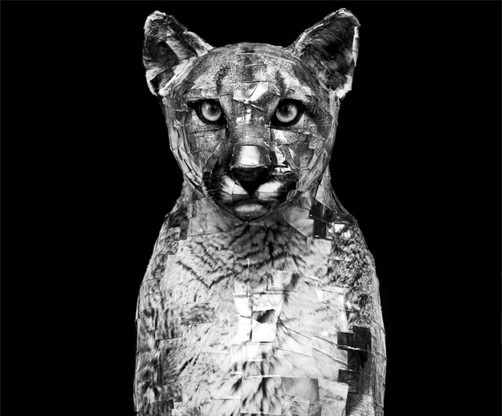
Osang: To explain in simple terms, I use two-dimensional cutout photographs from magazines like sculpture. These cutout sheets of objects are supported by wires allowing them to stand on its own, and these pieces are made into an installation. This installation is then photographed which is the end product in two-dimensional form. I'm not very extraordinary in claiming that ‘The Flat’ is a sculpture. We have other examples in contemporary art. Gilbert & George, for example, created a large painting of themselves in an English garden holding hands that was exhibited in Amsterdam in the 1980's.
This work is not really known, but anyhow, it says in the catalog that it is a sculpture consisting of paint placed on top of a wooden canvas. Perhaps my claims to ‘The Flat’ being a sculpture have something to do with such examples. One critic harshly described ‘The Flat’ as "art of stealing." Photographers who work with watches and jewelries are important artists in the field of commercial photography. Their clients pay huge sums of money to have those little objects photographed, and the photographers invest much time and effort in their work. But I cut them up and put them together to create one piece of artwork.
Because all the fragments are from top quality prints of excellent photographs, and because I use a large camera, the result is often quite impressive. With enough lighting one can get a very three-dimensional photograph. Another interesting issue is copyright. The greater the number of copyright holders involved, the more difficult it gets to file a suit for copyright infringement. Take one of my works of photographs of jewelry, Chanel, Tiffany, Hermes, Cartier and countless other designer houses are involved, as well as many other advertisement companies and photographers. In the end, it becomes technically impossible to make copyright claims. It seems that I've very easily exploited the work of others and in this regard that critic had referred to my work as "art of stealing."
Juhl: Usually artists start to plan out their next piece as their current series is coming to an end. Have you any ideas for your next work?
Osang: The next concept I have in mind is art that can neither be owned nor collected. At the same time, I realize that even if I make such an endeavor, the galleries will probably find a way to turn them into a saleable item. A pertinent example would be the sand mandala drawn by Tibetan monks. Buddhist monks in their self-discipline spend weeks creating sand mandala after which they sweep it away into the river to signify that life is transient.
However, if you visit Buddhist museums you'll find such mandalas glued to a canvas for display. So I'm guessing that my next work will probably be made into a form that can be owned. ‘The Flat’ also embodies a similar concept, the transience of excess, if you can call it that. In The Sculpture I also painted things that are heavy to make them look lighter. To me, this society is futile and temporal. There are always two sides of the coin to everything, and everything is cyclical. My view of life is pretty much based on this belief.
III. An Error in Game
Osang: After my works became more varied in style, I looked back on past works and pondered about what I was really interested in. Some artists concern themselves with death, others work on yet another subject, and what is it for me? What is that major thesis in my work of art? In the end I came to the conclusion that I seek to make art about art. I remember one time when I and some other artists talked about their own work late into the night. I ran across one of them a couple of days later and she said: "So basically you are putting up a performance of being a sculptor." Personally, I don't like performances, but the more I think about that comment the more relevant it sounds.
Juhl: Describing your work as a performance means that you borrow from and take advantage of that which is sculptural to create works that are similar to sculptures but are not really sculptures. So my question is what is your motivation? Is it a strategic motivation to exploit those sculptural qualities to create successful artworks? Or is it more like an artistic destiny--ie you are creating becaues you were fated to do so?
Osang: I often tell my acquaintances that I like the concept of "an artist sent from heaven" or an artistic genius, but that I don't believe in such. I believe there are two types of people, those that really do not believe in the existence of a genius and the other, only denying the existence of a genius to be modest (where in reality, they believe they are the 'genius'). I think I belong to the latter case. Not to brag that I'm a fabulous artist, but to show that I have a certain conviction in my work. Like the time I first exhibited ‘Deodorant Type’, I said "There is no genius in art".
Juhl: Do you mean like the slogan "Media makes the artist", which you submitted for your graduation exhibition?
Osang: Yes, quite similar. But when copies of my work started appearing in the art scene, I stopped saying that. I think I identify little holes and gaps in the art world and choose more game-like methods.
Juhl: Looking for the niches in the art world can seem very strategic. People will say you're real smart. Do you actually refer to books on modern philosophy, art theory, and art history to do your work?
Osang: As a student I tried to find answers about art through modern theories and philosophical literature. In high school I started reading such theoretical literature rather than novels as other kids would. Yet the complex ideas explicated in such books were incomprehensible. Now I think it was probably an issue of faulty translation. I had a professor who taught theories effectively and made them easy to understand. The books he recommended were often written like essays. As a young student I attended many lectures given by famous curators and influential people in the art world.
On a couple of these occasions I ran into the professor and told him there was not much to gain from the lectures. And he would tell me that it is enough that I learned that much. Today I think of books on modern philosophy and other academic literature as treatises on what we can naturally learn from our daily lives, presented in a more succinct and organized manner and accompanied by examples perhaps, but no grand revelation is in such books. It may sound a bit pretentious but this way of thinking has cleared away much of the illusion I had about theories.
In fact I devote more time to seeing what other artists have done than to studying theories. I read a lot of fashion and art magazines. This is very important for my work, especially to find true originality in artworks. An artist who does not go to exhibitions, who does not read about art and culture in the latest media are like a real estate agent who does not keep up with the latest news in the property market. I do not make a special effort to study academic literature or discourse.
Juhl: I majored in art theories. There were times when I was studying art history or aesthetics or was appreciating paintings in art books and felt like I was actually studying philosophy. And I realized that a truly valuable work of art does not follow the contemporary discourse but leads it by raising important issues. Therefore, new theories should take note of cultural phenomena and trace them rather than the other way around. In fact, many books in modern philosophy present works of artists as examples. I feel that your work has many qualities that can not be expressed in language and in this regard it delivers the sensitivities of the times before theories and language do. What do you think about this?
Osang: I had thought about that. And who knows? I think artists will make such endeavors and to a certain degree it will come true. But I'm not sure if art is really in the leading position. On the other hand, I feel what you have said may be true, it may in fact be quite relevant to ‘The Sculpture’. I can't predict the far-off future, but I am guessing that there is a great possibility. I heard something similar about natural science. Scientists often start a research on their gut feeling without setting a defined hypothesis. The same is true of writers and probably businessmen, too.
People often tell me that I look like a very rational person, but actually I'm not so rational. Perhaps it is part of my performance of trying to become a sculptor. A sculptor, Gwon, Osang, who doesn't look like a sculptor sculpts. A person looked like a neatly organized person but turns out his house is a mess. A student seemed like a computer whiz, but proved not to be. Such misperception of a person based on his or her appearance is common in life. And I concluded that the world is a constant continuation of such misunderstandings. The world of misunderstandings and misperceptions was the motif for the 2000 exhibitions titled "Disturbance" and "Error Interchange".
Juhl: Do you mean 'misunderstanding' is a major subject of your work?
Osang: I had an exhibition with a group of photographers once. I named the exhibition "Fallacy Interchange." "Disturbance" is the title of an exhibition held in an alternative space which was actually organized on an open bidding basis. Only groups consisting of three or more artists could apply. But my friend and I had a different idea. We wanted each to hold separate exhibitions on the two floors, and the gallery space was not enough for us to invite another to join in. So we created a non-existent person, with a fake portfolio, fake CV and a fake interview to create this 'misunderstanding.'
Juhl: Your work is almost like a strategic game. If we look at the characteristics of your work, you draw out the things that contemporary art has overlooked. Visually, the images are very strong and overwhelming, and they are often unrealistic and weird. Is there a rule to the game in the way you work?
Osang: The most important rule is to include various codes that can be interpreted in multiple ways. I don't believe in having my messages delivered accurately. I'm just giving the audience a number of signs for them to find their way to the destination. This may seem callous but I think it is actually the nicest answer to the audience. After seeing a film some moviegoers would often say the film was too difficult to understand. I think it is impossible to see a visual image and think of it as being too complex. All you have to do is just look at what is passing before your eyes.
The audience has only to see it and interpret it based on their own life experiences. I think there is a range of communication that can be achieved through contemporary art. People at times daydream when they are really busy. I believe that communicating that daydream is a key function of contemporary art. I sometimes think to myself that an artist is somebody who sits at a quite café and enjoys himself in place of other people who are too busy to do so. In fact, I personally think that artists should have greater leisure to produce better work. When an artist is too preoccupied, the works will often suffocate.
Juhl: Your work often carries debates about commercialism. I think it stems from misperceptions about your work, which seems very neat and sophisticated, and uses expensive products as the subject. On a personal level, I think that those misperceptions are in some ways similar to the criticisms of Andy Warhol at his time. What is your own personal opinion on this?
Osang: Although it is true that I use designer goods and other luxury items, it is not to make my work marketable. As I worked on The Sculpture, which is based on 'super cars', I thought to myself. Who would actually buy my work? An art museum ten years from now, or an Arab prince who collects both cars and art? Some people commented that now I am doing monuments, and others say that I have started making expensive to fabricate bronze sculptures, since I joined a commercial gallery. Amidst all this talk I became sad. Automakers will not buy my sculptures because they would think their products are more beautiful.
On the other hand, my sculptures are not something that can be installed in front of a public office or an apartment complex. My work is the kind that has to end up in a museum. ‘The Flat’ is not something that can be hung up in the office or a living room. If I'd wanted to work with a company I would have chosen the cosmetics of that firm or another particular watch. Just as my work involves copyright issues, it contains many different brands and no company is likely to volunteer to acquire it. The only people who'll take interest in it will be watch collecters and collectors who may understand and take a liking to my work. At first, when I started ‘Deodorant Type’ I did not expected it to sell. I'd thought about making editions, but decided against it since I realized that my works were not commercial.
Whether my work sells or doesn't sell is not the issue. People buy works from a gallery when they like the pieces but more often it is because of the artist's reputation and aura. To add, it is more common for people to buy based on the gallery's reputation rather than the artists'. Likewise women buy Gucci not only because it is beautiful but it is Gucci. If an artist crumpled up some papers and stuck them on the wall, a collector would probably buy the entire wall if it was shown at Gagosian. I think it is wrong for an artist to make only those things that will be marketable. Many factors are involved in selling a work and for me, I would rather concentrate on putting my ideas and philosophy in my work, whether anybody is interested or not.
Juhl: You have a distinct style that runs through all your work, and your works are evolving in that world. But some artists, whether for better or worse, break away from the old and present something completely new. When do you think you will start doing this?
Osang: Unless my life or environment changes significantly, I'll probably stay pretty much the way I am. Of course my life has changed somewhat but I haven't changed much in terms of the way I think. Some artists have a set style while others don't. As for me, I became known for the photographic sculpture of ‘Deodorant Type’, and later people praised me for breaking away from that in ‘The Flat’. But from my perspective I don't see any major change.
People say that ‘The Sculpture’ is a big shift, but little has changed in the way I work. In the studio, I've made them in paper mache and they're easily moved about. But even for those artists who don't have a defined style, we can still recognize his work even when he works in different spaces. The work of a true artist will have that distinct feel of the artist. I, too, may change in the future but probably not to a great extent. Just as one's constitution does not change so easily.
IV. The Artist
Juhl: You said that your work is art for art's sake, or meta-art. What is it that you want to achieve in your work?
Osang: I have asked myself that question. What do I want in my work? What is that great thesis? These questions ultimately link to my personal interests and I think my greatest interest lies in finding the means to be a contemporary artist. The work itself is important but I seem to have a special interest in the artist. Ultimately, it is a good artist who will make good sculptures. I sometimes ask myself: 'Are you leading a good life?' Ultimately it is living itself that is my goal, to live in security and happiness despite my vocation as an artist. I don't want anything grand. All I hope for is that when I find the love of my life her family will not object to our relationship on account of my being an artist. I hope this becomes true for everyone.
Juhl: You think a lot about your identity as an artist, and it shows in your work. In your work, I can see where you pondered over the identity of sculpture, and of photography and design, too. When we draw a parallel between taking interest in the daily life, identity, artist's domain, characteristics and the domain of sculpture, do you think there is a direct link between life and work?
Osang: In reality, yes. But I would logically argue otherwise. I want people to recognize Gwon Osang the artist and Gwon Osang the person as two different beings, because artist Gwon Osang seems more attractive than Gwon Osang the average person. The most important thing in one's work or life is not about what to do next, but to really understand one's tastes and behavioral patterns. Then, the answer is easy to get.
Writings